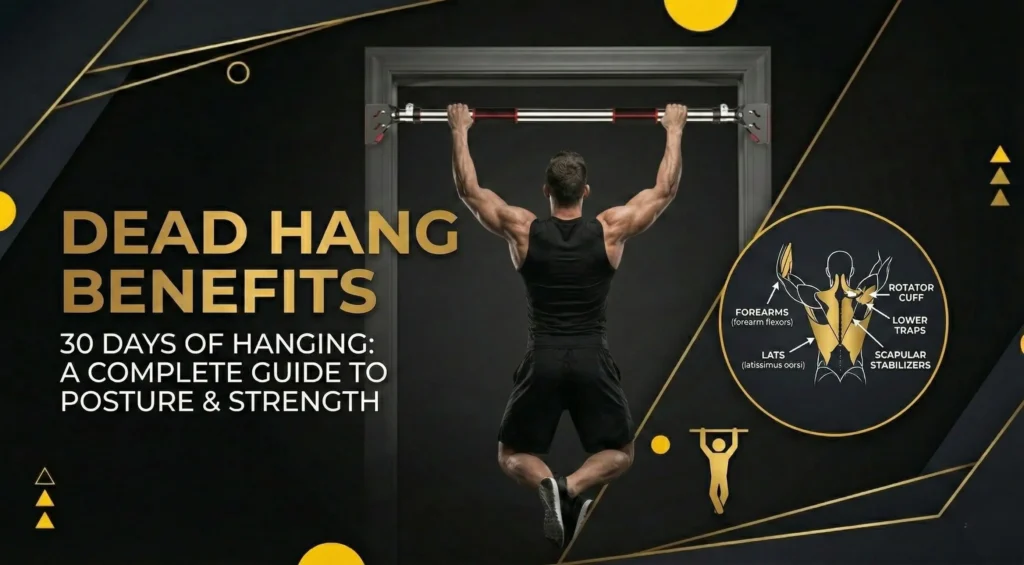
The dead hang exercise is deceptively simple: grasp an overhead bar, suspend your body, and hold. Its clearest training benefit is grip endurance, while the experience of shoulder stretch, overhead mobility, and comfort can vary by person and technique. This guide breaks down a 30-day progression with clear technique cues, practical variations, and equipment considerations for bodyweight training at home.
Quick primer: what a dead hang is and why it matters
A dead hang is a passive or active hold performed from a bar with arms fully extended. The difference:
- Passive hang: shoulders are relatively relaxed, with a comfortable overhead stretch; any spinal decompression effect should be treated as temporary and individual rather than guaranteed.
- Active hang: shoulders depressed, lats engaged emphasis on lat engagement, scapular activation, and dead hang pull ups benefits.
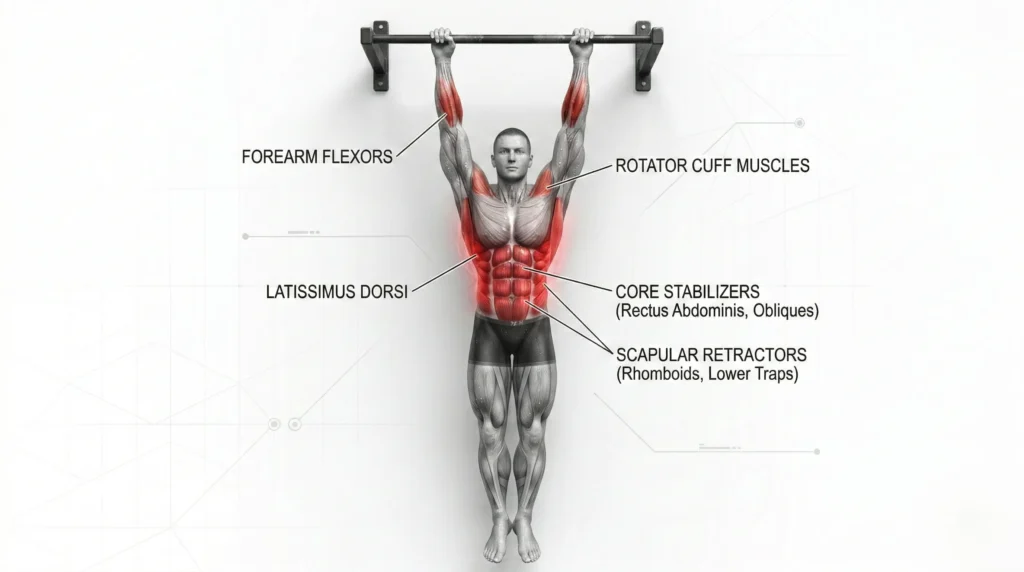
Muscles involved in a dead hang can include the forearm and finger flexors, with the lats, lower traps, rotator cuff stabilizers, and trunk contributing depending on whether the hang is passive or active. The exercise is especially useful for practicing grip endurance and overhead control; posture and mobility effects vary with the individual.
How to do dead hangs (technique checklist)
Dead hang technique matters. Follow this checklist every set:
- Wrap the full palm around the bar don’t just grip with fingertips.
- Keep wrists neutral.
- For passive hangs: relax shoulders slightly and let the spine decompress.
- For active hangs: depress the shoulders, engage the lats, and brace the core.
- Breathe steady; do not hold breath.
- Avoid excessive swinging; keep legs stable.
If the dead hang hurts lower back, check pelvic tilt and reduce duration until neutral posture can be maintained. Use active core bracing to reduce lumbar stress.
30 Days of Hanging
Day 1 — First attempt: 10 seconds.
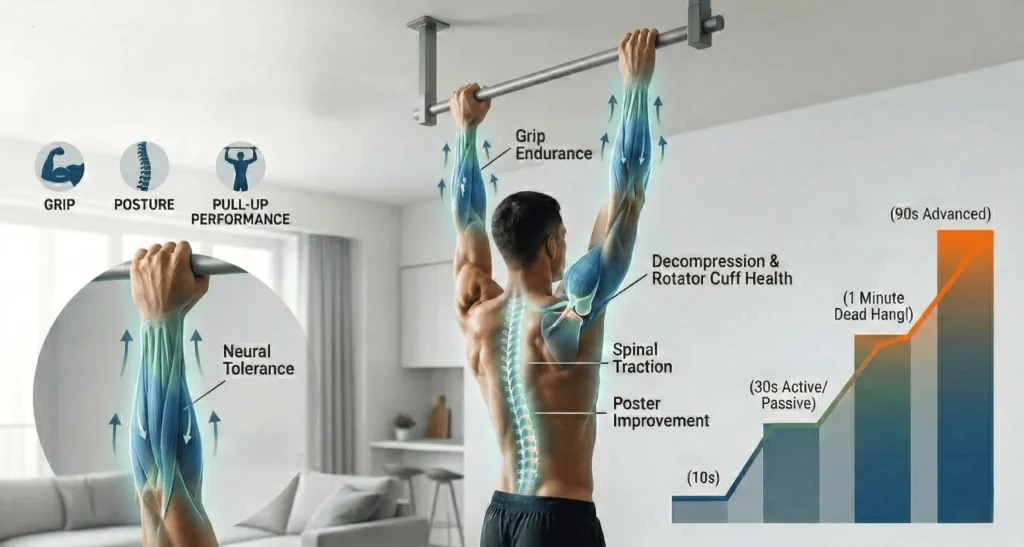
Baseline testing shows reality: many trainees hold 10 seconds on their first attempt. That confirms the primary limiter: forearm fatigue and insufficient neural tolerance in hand/finger flexors. The dead hang test at day one sets the dead hang time starting point and identifies technical errors.
Key takeaway: early holds reveal whether grip or shoulder control is the limiting factor.
Day 2–4 — Still stuck at 10 to 15 seconds.
This plateau is normal. Repeated short holds teach the nervous system to tolerate the sustained isometric stress. During this phase, focus on dead hang technique full palm wrap, even pressure distribution, breathing, and minimal swing. Implement short passive micro-sessions throughout the day as a simple dead hang routine to build tolerance without excessive fatigue.
Training note: these days demonstrate how effective dead hangs for forearms are at producing local endurance quickly.
Day 5 — A different bar changes everything.
A critical, often overlooked variable is equipment. Bar diameter and texture strongly affect performance. Switching to an appropriately sized bar produced immediate improvements in hold time for the trainee. Even using an adjustable pull Up bar at home requires attention to grip diameter and secure mounting.
Practical tip: if a bar is too thick or too rough, grip efficiency drops. Choose a bar that allows a full hand wrap without finger compromise.
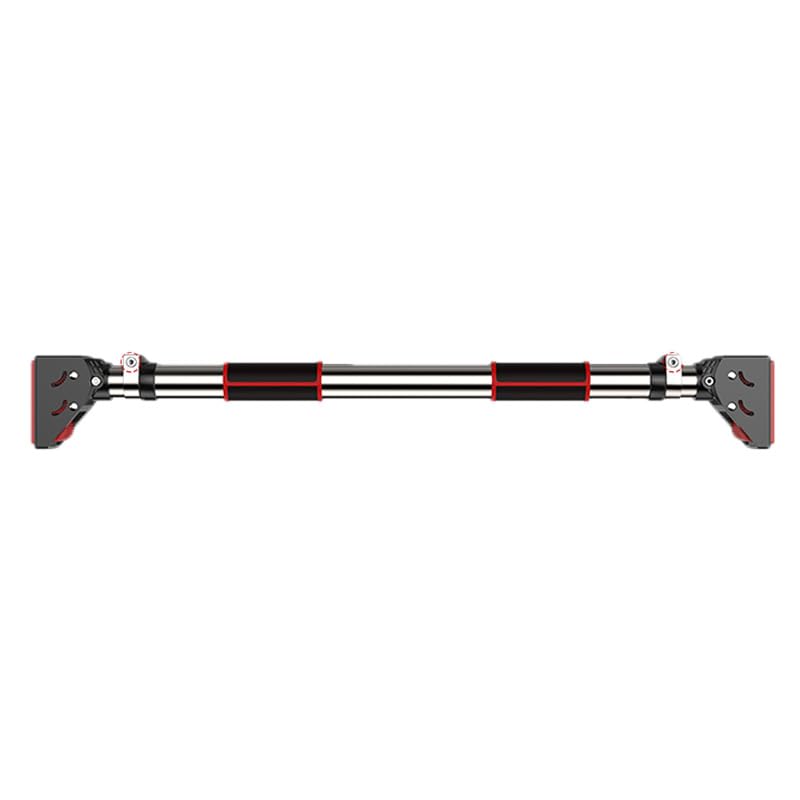
PROIRON PRO MSDG01-1
The PROIRON PRO-MSDG01-1 Adjustable Pull-Up Bar is built with thick stainless steel and alloy steel, rated to support up to 200 kg for solid home workouts. Its telescopic design (72–92 cm) fits most standard door frames, with a dual locking mechanism for added stability. High-density foam grips provide a firm, sweat-absorbing hold to reduce hand fatigue during longer sets. PVC anti-skid pads help protect the door frame while improving grip against the surface. Designed for pull-ups, chin-ups, leg raises, and more, it’s a compact strength-training option for home use.
Day 6 — I hit 40 seconds, then slip off.
Breaking past thirty seconds indicates real adaptation. Grip endurance has improved, but localized fatigue still triggers slips. At this stage, focus on incremental overload: more sets, slightly longer holds, and careful rest. Grip mechanics refine knuckles tilted slightly upward, even pressure, and breathing under load.
Day 9 — Hanging becomes the warm-up.
By day nine, hanging shifts from novelty to utility. The hold serves as a shoulder mobility and activation primer before pull-up work. Use passive holds for shoulder decompression and active holds to drive lat engagement and scapular activation. Implement short sets before pull-up progressions to enhance the pull up from dead hang start.
Benefit: regular passive holds act as a mobile desk posture fix between long sitting sessions.
Day 10 — Scrolling through a tutorial, realized something awful.
The often-missed technical leap is shifting from passive to active work. Passive hangs primarily provide spinal traction and stretch. However, active hang training transforms the hold into a strength tool: it builds rotator cuff resilience and better transfers to pull-ups. Adopt active scapular depression drills, and short isometric holds to escalate benefit.
Day 11–17 — Controlled progression phase
During these days, implement a structured dead hang workout:
- 3–5 sets per session
- Mix passive and active hangs
- Rest 60–90 seconds between maximal holds
- Include scapular pulls and isometric lat tension
This period consolidates dead hang benefits: increased overhead mobility, improved spinal traction tolerance, and reduced forearm fatigue during repeated efforts.
Day 18 — The 1 minute dead hang benchmark
A 1 minute dead hang is a meaningful milestone and aligns with common dead hang time standards. Reaching this indicates a substantial increase in grip endurance, better rotator cuff conditioning, and improved scapular control. For programming, a minute is a logical threshold to progress into variations such as towel grip dead hang or light weighted dead hang work.
Day 19–28 — Pushing 90 seconds regularly
Consistency now produces advanced endurance. Hitting 90 seconds regularly improves structural capacity rotator cuff load tolerance, lat engagement, and improved pull-up economy. Compare this phase to other forms of grip work: dead hang vs farmers walk shows complementary adaptation. Farmers walks build loaded carry strength; dead hangs specifically develop overhead endurance and joint decompression tolerance.
Programming tip: alternate heavier grip-focused days (towel or weighted holds) with mobility-focused passive sessions to manage recovery.
Day 29–30 — I feel unstoppable. The hangs feel solid and steady now.
At this endpoint, hangs are no longer survival tasks; they are calibrated tools. Dead hang pull ups benefits become obvious: smoother pull-up initiation, fewer early failed reps, and consistent scapular control. Posture improves: shoulders sit back, thoracic extension increases, and the spine tolerates overhead positions far better. The cumulative hanging exercise benefits are now clear across function and comfort.
Dead Hang Variations, progressions, and alternatives
- One arm dead hang: advanced. One arm dead hang benefits include unilateral grip overload and rotator cuff challenge. Only adopt once two-handed holds exceed 90 seconds and technique is flawless.
- Towel grip dead hang: increases diameter to tax finger strength and mimic climbing-specific demands. Rotate towel sets into weekly programming.
- Weighted dead hang: use small increments of external load after consistent 60–90s holds. Weighted progression significantly increases mechanical stress for strength gains.
- Dead hang alternative / alternative exercise to dead hang: band-assisted hangs, lat pulldown holds, or inversion traction provide partial stimuli when a bar is unavailable, but none fully replicate the overhead suspension loading.
Programming example (4-week microcycle)
Week 1: 4 sets x 20–30s (passive), daily micro-hangs (2–3 x 10s) as posture work.
Week 2: 4 sets x 30–45s (mix passive/active), include 2 active scapular sets.
Week 3: 3–5 sets x 45–60s (aim for 1 minute dead hang), add towel grip cluster once weekly.
Week 4: 3 sets x target (work toward 90s), introduce one weighted set if comfortable.
Daily frequency: dead hangs everyday is possible if volume is modulated alternate high-intensity days with mobility-focused passive sessions.
Safety, recovery, and common issues
Dead hang hurts lower back often when pelvic position is exaggerated. Correct with a neutral pelvis and light core bracing. If pain continues, pause and address thoracic mobility and core conditioning.
Forearm fatigue is expected; mitigate with progressive exposure and adequate recovery. Use soft-tissue care and limit towel sessions until skin and tendons adapt.
For rotator cuff health, include shoulder mobility drills, rotator cuff band work, and controlled active hangs to build dead hang rotator cuff resilience.
Why the dead hang matters for home trainers
For bodyweight training at home, the dead hang is high-return, low-cost. It provides a unique combination of spinal traction, joint decompression, and a direct bridge to pull-up strength. Implementing targeted hangs in the warm-up or as stand-alone sessions provides a practical dead hang workout accessible to most trainees.
Equipment: a stable pull-up bar or secure doorway rig is sufficient. An Adjustable Pull Up Bar that provides correct grip diameter and stable mounting will serve many home setups well. If you are still working toward your first pull-up, see our beginner pull-up guide.
Final summary: core dead hang benefits
- Grip endurance improves dramatically with progressive exposure.
- Shoulder decompression and spinal traction produce real comfort gains for desk workers.
- Overhead mobility, lat engagement, and scapular activation transfer directly to improved pull-up mechanics.
- Dead hang pull ups benefits include better initiation and fewer early failed reps.
- Variations like towel grip dead hang, one arm dead hang, and weighted dead hang provide scalable overload.
- For home use, a properly chosen bar or Adjustable Pull Up Bar is essential.
Implement a clean dead hang routine, track dead arm hang time, and progress patiently the result is stronger hands, healthier shoulders, and a posture that reflects the work.
Related Pull-Up Training & Equipment Guides
- Master the Dead Hang: Form, Variations & Tips
- 7 Dead Hang Mistakes to Avoid
- How to Do Pull Ups at Home
- Best Pull-Up Bars for Home in India
FAQs
What are the main dead hang benefits?
The primary dead hang benefits include improved grip endurance, stronger forearms, better shoulder decompression, enhanced overhead mobility, and improved pull-up performance. Consistent practice also supports spinal traction and posture correction, especially for desk workers.
How long should you dead hang as a beginner?
If you’re new to the dead hang exercise, start with 20–30 seconds per set. Gradually build toward a 1 minute dead hang as your grip endurance improves. Advanced trainees can aim for 90 seconds or more based on standard dead hang time standards.
How long to dead hang for posture improvement?
For posture correction, short passive holds (15–30 seconds) multiple times daily are effective. The dead hang stretch promotes spinal traction and shoulder decompression, helping reverse rounded shoulders and acting as a practical desk posture fix.
Does dead hang increase height permanently?
No, does dead hang increase height is a common myth. Hanging can temporarily decompress the spine through dead hang spinal decompression, which may slightly increase measured height for a short time. However, it does not permanently lengthen bones.
What muscles are worked during a dead hang?
The main dead hang muscles worked include forearm flexors, finger flexors, lats (during active hangs), lower trapezius, and rotator cuff stabilizers. Active hangs also improve scapular activation and lat engagement for stronger pull-up performance.
What is the difference between dead hang vs farmers walk?
When comparing dead hang vs farmers walk, the key difference is direction of load. Farmers walks build loaded grip strength and conditioning, while dead hangs focus on overhead stability, spinal traction, and improving pull up from dead hang mechanics.
Is it safe to do dead hangs everyday?
Yes, dead hangs everyday can be safe if volume is controlled. Alternate passive and active sessions to manage forearm fatigue. Avoid excessive volume if the dead hang hurts lower back or causes shoulder irritation.
What is a good dead hang time standard?
General dead hang time standards suggest:
30 seconds = beginner
60 seconds = strong intermediate
90–120 seconds = advanced
Tracking dead arm hang time weekly helps measure grip progress accurately.
Are weighted dead hangs better for strength?
A weighted dead hang increases mechanical tension and accelerates grip and lat strength gains. However, it should only be introduced after mastering a consistent 60–90 second bodyweight hold.
What are the benefits of one arm dead hang?
One arm dead hang benefits include extreme unilateral grip development, improved rotator cuff strength, and enhanced scapular stability. It is an advanced progression and should only be attempted after strong two-handed hang capacity.
What are the long-term dead hang benefits for shoulder health?
Long-term dead hang benefits for shoulder health include improved rotator cuff stability, stronger scapular activation, and better shoulder decompression. Regular hanging reduces joint compression and increases overhead mobility, which helps lower the risk of shoulder impingement during pull-up and pressing movements.
Do dead hang benefits improve pull-up strength?
Yes, one of the most practical dead hang benefits is improved pull-up performance. Training the bottom position builds grip endurance, lat engagement, and starting strength, making it easier to execute a clean pull up from dead hang without early failure.
Are dead hang benefits useful for beginners in bodyweight training?
Absolutely. For beginners, dead hang benefits include foundational grip strength, improved joint stability, and better posture alignment. It is one of the safest entry-level pull up bar exercises for developing upper-body control in bodyweight training at home.
Can dead hang benefits help reduce back tightness?
Yes. Passive hanging promotes spinal traction and gentle decompression. Among the most underrated dead hang benefits is reduced upper back stiffness caused by prolonged sitting, making it an effective daily mobility tool.
How quickly can you notice dead hang benefits?
Most people begin noticing early dead hang benefits within 1–2 weeks, including increased dead hang time and reduced forearm fatigue. Posture and shoulder decompression improvements typically become more noticeable after 3–4 consistent weeks.