Pull ups are one of the most rewarding exercises you can add to your routine but they’re also one of the most commonly butchered. Whether you’ve just installed a doorway pull up bar at home or you’re training at the gym, the difference between results and frustration often comes down to a handful of fixable mistakes.
If you’re serious about building upper body strength, improving your grip, and finally nailing that clean rep, read this before your next set.
Why Pull-Ups Are Worth Getting Right
Before diving into the mistakes, it helps to understand why pull-ups are useful. They train the lats, biceps, upper-back muscles, and trunk as part of a compound pulling movement. Machines can train many of the same muscles, but a pull-up also requires you to control your bodyweight through space.
With the rise of home gym pull up bar setups across India and globally, more beginners are attempting pull-ups without the guidance of a trainer. That’s great for accessibility but it also means bad habits are forming in bedrooms and living rooms everywhere.
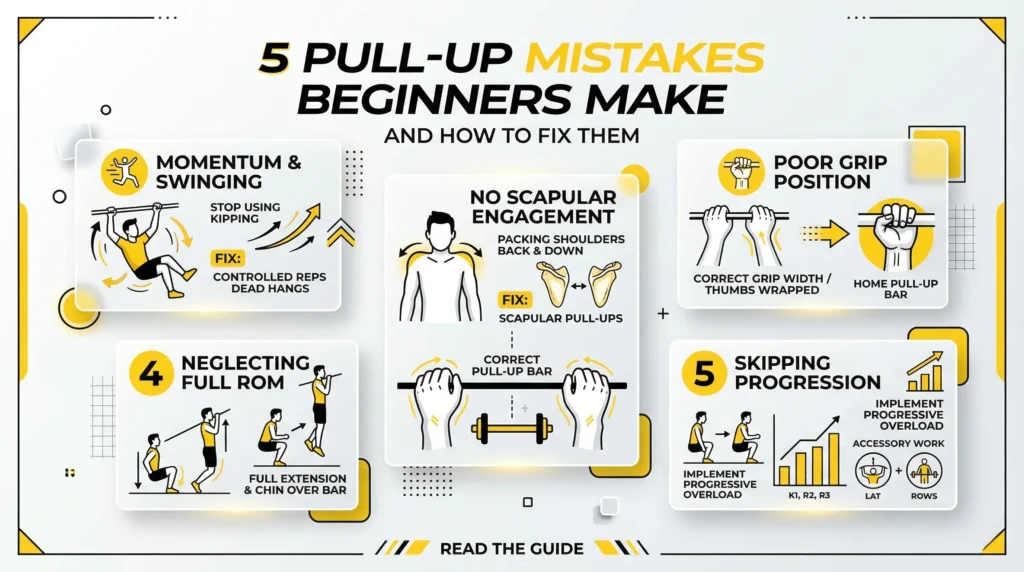
Mistake #1: Using Momentum Instead of Muscle
What it looks like: You swing your legs, kip your hips, and basically throw yourself over the bar. The rep gets done but your muscles didn’t do the work.
Why it happens: Pull-ups are hard, and when you can’t complete a full rep, the body finds shortcuts.
How to fix it: Start with dead hangs. If you want the background, read our dead hang benefits guide. A controlled hang can help you practice grip endurance and shoulder control, but progression should match your current capacity rather than following a rigid timeline.
Slow your negative (lowering phase) down to 3–5 seconds. That eccentric control is where real strength is built.
Mistake #2: Not Engaging the Scapula at the Start
What it looks like: You hang passively and immediately pull with your arms elbows flaring, shoulders creeping up to your ears.
Why it happens: Most beginners don’t know about scapular retraction. It sounds technical, but it’s simple: before pulling, you need to “pack” your shoulder blades down and back.
How to fix it: From a dead hang, practice scapular pull-ups. Without bending your elbows, squeeze your shoulder blades together and down your body will rise slightly. That’s the activation you need at the start of every rep.
This correction can make the movement more controlled and may reduce unnecessary shoulder stress, but it is not a guarantee against injury.
Mistake #3: Gripping the Bar Too Tight or Too Narrow
What it looks like: White-knuckle grip, wrists bent awkwardly, or hands placed too close together causing the elbows to flare inward.
Why it happens: People naturally over-grip when they’re nervous or fatigued, and most beginners default to a narrow grip because it feels more “secure.”
How to fix it: Aim for a grip slightly wider than shoulder-width. Wrap your thumbs around the bar (don’t go thumbless until you’re experienced). Grip firmly but not with maximum tension imagine you’re trying to “bend” the bar outward. This external rotation cue activates your lats far more effectively.
This is also why equipment choice matters. An adjustable pull up bar can offer more flexibility in positioning than a fixed-width bar, although the usable grip range depends on the model. If you consider a product such as the Slovic pull up bar, check its actual dimensions and stated grip positions rather than assuming every adjustable model fits the same way.
Mistake #4: Neglecting Full Range of Motion
What it looks like: Half-reps where you stop when your chin reaches bar level, or you never fully extend at the bottom.
Why it happens: Ego. Incomplete reps feel like complete reps if you’re not paying attention, and stopping at the top looks like a finished movement.
How to fix it: Start from a full dead hang every single rep. Your arms should be completely extended at the bottom. At the top, aim to get your chin clearly over the bar not just level with it. If you can’t do full range reps yet, do fewer reps with better form. Three perfect reps beat ten sloppy ones every time.
Full ROM also ensures your biceps, forearms, and shoulder girdle get equal stimulus across the entire movement arc.
Mistake #5: Skipping Progressive Overload and Accessory Work
What it looks like: You do the same 3 sets of 5 reps every week for months and wonder why you’re not improving.
Why it happens: Pull-up programming is overlooked. Most people treat it as a warm-up or a finisher rather than a primary strength movement deserving proper progression.
How to fix it: Apply the same principles of progressive overload you’d use on a barbell lift. Add reps weekly, then add sets, then add load (via a weight belt or vest). Pair your pull-up training with:
- Lat pulldowns (great for beginners who can’t yet do a full rep)
- Inverted rows (trains the same horizontal pull pattern)
- Farmer carries (grip and forearm strength)
- Face pulls (rear delt health and rotator cuff stability)
For those training with home gym equipment pull up bar setups, the Roughhouse pull up bar is built to handle added load making it a solid option if you plan to eventually train weighted pull-ups at home.
Setting Up Your Home Pull-Up Station the Right Way
Your equipment setup matters more than people realise. Here’s what to look for:
Doorway pull up bar: Ideal for renters or those with limited space. Look for models with thick foam padding and multiple grip positions. Make sure the doorframe width is compatible and always check the weight capacity before loading up.
Pull up bars for home (wall/ceiling mounted): More stable for heavy training. These allow wider grips and won’t shift mid-set. If you’re serious about training, this is worth the installation effort.
Adjustable pull up bar: The most versatile option. You can change grip width, height, and even angle. Great for households with multiple users of different heights.
Whatever setup you choose, inspect it regularly. A bar that shifts at the top of a rep is a serious injury risk.
Quick Reference: The 5 Mistakes and Their Fixes
| Mistake | Fix |
|---|---|
| Using momentum | Practice dead hangs and slow negatives |
| No scapular engagement | Add scapular pull-ups before full reps |
| Poor grip position | Slightly wider than shoulder-width, thumbs wrapped |
| Partial range of motion | Full hang at bottom, chin over bar at top |
| No progression | Track reps, sets, and add load over time |
Related Pull-Up Guides
- How to Do Pull Ups at Home
- Dead Hang Benefits
- How to Install a Doorway Pull-Up Bar
- Best Pull-Up Bars for Home in India
Final Thoughts
Pull-ups are a skill before they’re a strength movement. The five mistakes above aren’t signs that you’re bad at training they’re signs that no one explained the technique properly. Fix the foundations, be patient with your progression, and the strength will come.
Whether you’re using a doorway pull up bar in a Mumbai apartment or a full wall-mounted rig in your garage gym, the principles are the same. Train smart, track your progress, and never skip the basics.
How many pull-ups should a beginner aim for?
Start with 1–3 clean reps with full range of motion. Quality always beats quantity. Over 4–6 weeks, work toward 3 sets of 5 reps before increasing volume or adding load.
Is a doorway pull up bar safe for heavy use?
Yes, if it’s properly fitted and within its stated weight capacity. Always check the doorframe compatibility and inspect the bar before each session. For weighted pull-ups, wall-mounted pull up bars for home are generally safer.
What is the best pull up bar for home use in India?
Options like the Slovic pull up bar and Roughhouse pull up bar are popular among Indian home gym users for their build quality, grip comfort, and value for money. Choose based on your available space and training goals.
Can I do pull-ups every day?
Not recommended for beginners. Your muscles need 48 hours to recover. Train pull-ups 3 times per week and use off days for accessory work or lower body training.
What muscles do pull-ups work?
Pull-ups primarily target the latissimus dorsi, biceps brachii, and rear deltoids. They also engage the rhomboids, teres major, and core stabilisers throughout the movement.
What is the difference between a pull-up and a chin-up?
A pull-up uses an overhand (pronated) grip and emphasises the lats. A chin-up uses an underhand (supinated) grip and places more emphasis on the biceps. Both are excellent movements and can be done on the same home gym pull up bar.
How do I build up to my first pull-up?
Start with dead hangs (2–3 sets, 20–30 seconds), progress to scapular pull-ups, then to negative pull-ups (jump to the top and lower slowly). Assisted band pull-ups are also effective. Read more about dead hanging benefits as a starting point.
Can an adjustable pull up bar support different grip widths?
Yes. Most quality adjustable pull up bars allow you to change the grip width to target different muscle groups — narrower for bicep emphasis, wider for lat activation.
Is a home gym pull up bar enough for a complete upper body workout?
A pull up bar covers vertical pulling movements comprehensively. For a complete upper body routine, supplement with push-ups, dips, and rows. Many home gym dynamics pull up bar setups include dip bars and push-up handles for this reason.
Why do my shoulders hurt after pull-ups?
Shoulder pain is usually caused by skipping scapular engagement (Mistake #2 above), using too wide or too narrow a grip, or programming too much volume too soon. Fix your form first. If pain persists, consult a physiotherapist before continuing.