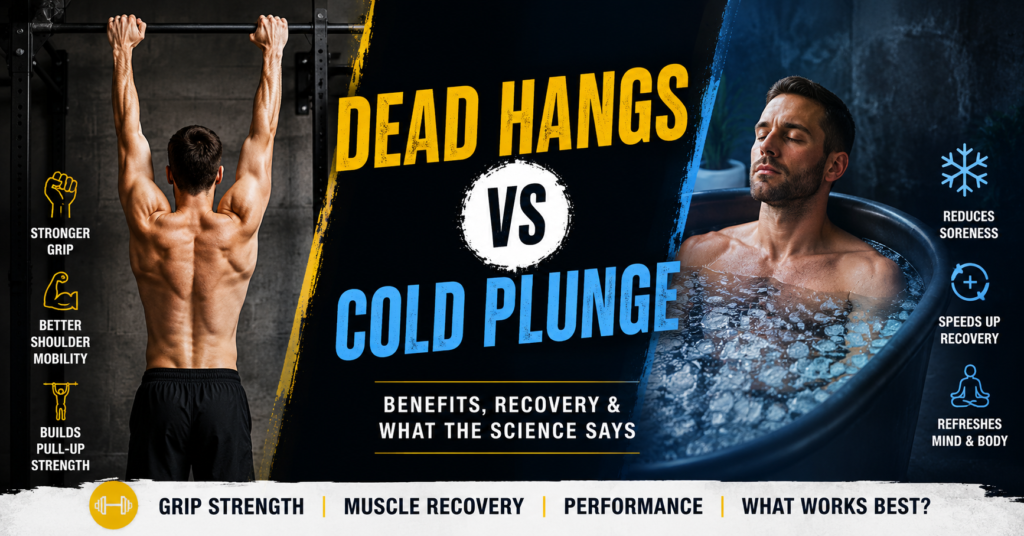
Dead hangs and cold plunges have become popular in very different corners of modern fitness. One asks you to suspend your body from a bar; the other exposes the body to cold water after exercise. They are sometimes discussed as recovery tools, but treating them as interchangeable misses the point. A dead hang is primarily a bodyweight training exercise that challenges grip and upper-limb endurance. Cold-water immersion is a recovery modality whose effects depend heavily on the type of exercise, timing, protocol and the outcome being measured.
This distinction matters if your goal is building pull-up strength at home. A dead hang can directly train a quality you need for hanging and pulling, while a cold plunge does not replace progressive strength training. At the same time, research suggests cold-water immersion can reduce soreness and improve some measures of short-term recovery after strenuous exercise, although frequent use immediately after resistance training may interfere with some long-term adaptations. A 2023 systematic review and meta-analysis found that the recovery effects of cold-water immersion varied with the exercise performed and the outcome measured.
Dead Hang vs Cold Plunge: The Short Answer
If your main goal is grip strength, hanging endurance or progressing toward pull-ups, the dead hang is the more directly relevant tool. If your goal is reducing perceived soreness or supporting recovery after certain hard sessions, cold-water immersion has substantially more direct research behind it.
That does not mean cold plunges are universally better for recovery, or that dead hangs are a recovery treatment. They solve different problems.
| Goal | Dead hang | Cold plunge |
|---|---|---|
| Grip endurance | Strong fit | Not a training substitute |
| Pull-up preparation | Directly relevant | Not directly relevant |
| Muscle soreness | Not its primary purpose | Useful evidence for acute recovery |
| Resistance-training adaptation | Can be part of training | Frequent immediate use may be counterproductive in some contexts |
| Equipment | Requires a secure overhead bar | Requires cold-water setup |
What Is a Dead Hang?
A dead hang is an isometric hanging exercise in which you support your body from an overhead bar, generally with the elbows extended. The simplest version is a passive hang, where the shoulders are relatively relaxed. An active hang deliberately involves the shoulder girdle and is a different training emphasis.
Dead hangs are especially relevant to people learning how to do pull-ups at home because the exercise exposes a beginner to the basic demand of supporting bodyweight from a bar. It can also provide a simple way to track hanging endurance over time.
Dead Hang Benefits: What Does the Evidence Support?
The most defensible way to discuss dead hang benefits is to focus on the qualities the exercise actually trains rather than promising broad effects that have not been established. A sustained hang places a prolonged isometric demand on the grip and upper limb. Research using dead-hang testing and related hangboard training shows that hanging duration can improve with specific training.
A 2025 study of physically inactive young men compared pull-up programs supplemented with forearm or core training. All groups improved dead-hanging time over eight weeks, while the forearm-training group also produced the largest grip-strength improvements. The study supports the basic principle that hanging endurance and grip capacity are trainable, although it was a small study and should not be treated as proof that dead hangs alone produce every claimed benefit. The full study is available through PubMed Central.
Dead Hang for Grip Strength and Pull-Ups
Grip strength is one of the clearest reasons to include hanging work in a pull-up progression. Your hands must maintain contact with the bar while the forearms resist fatigue. That makes dead-hang duration a useful practical measure of grip endurance, although it is not identical to maximal grip strength measured with a dynamometer.
Research on climbers also uses sustained dead-hang tests to evaluate finger endurance, and a 2022 randomized controlled trial found improvements in several climbing-specific strength measures after hangboard training, including dead-hang duration within the training group. PubMed provides the study details.
For a beginner, however, the takeaway should be simple: a longer dead hang can be a useful part of a progression, but it is not the same thing as being able to perform a strict pull-up. Pull-ups require coordinated pulling strength from the back and arms as well as grip endurance.
For a practical progression, see our guide to dead hang benefits and training, then connect the hang work to a structured pull-up progression at home.
What Is Cold-Water Immersion?
Cold-water immersion, often called a cold plunge, involves immersing part or all of the body in cold water. Unlike the term “cold plunge,” which is used loosely online, research studies use defined protocols involving water temperature, immersion duration, body region and timing relative to exercise.
That distinction matters because there is no single cold-plunge protocol that can be declared best for every workout. A 2026 systematic review and network meta-analysis covering 87 studies and 2,313 participants found that the apparent effects varied by exercise modality, water temperature and exposure duration, with many comparisons based on low-certainty evidence. The review is indexed on PubMed.
Cold Plunge Benefits: What Does the Research Actually Say?
The strongest reason people use cold-water immersion after strenuous exercise is recovery. A large 2023 systematic review and meta-analysis found that cold-water immersion can improve several short-term recovery outcomes, including perceived recovery and muscle soreness, but the effects differed according to the preceding exercise and the outcome measured.
Another recent systematic review and meta-analysis found that acute cold-water immersion reduced delayed-onset muscle soreness and creatine kinase compared with passive recovery. These findings suggest that cold water can influence some markers associated with exercise-induced muscle damage and soreness, but a lower soreness score should not automatically be interpreted as faster muscle growth or better long-term training adaptation. See the 2026 systematic review.
Does Cold Water Immersion Help Muscle Recovery?
The honest answer is: sometimes, depending on what you mean by recovery. If recovery means feeling less sore or regaining certain aspects of performance between demanding sessions, the evidence is reasonably supportive. If recovery means maximizing every long-term adaptation from resistance training, the picture is more complicated.
A 2021 review concluded that cold-water immersion can accelerate recovery of several acute measures, including muscle soreness and perceptions of fatigue, while also noting evidence that repeated post-exercise immersion may attenuate some resistance-training adaptations. A separate meta-analysis found a small attenuation of strength gains overall, although whole-body immersion did not show a statistically significant difference in its subgroup analysis. Read the review and strength meta-analysis.
Cold Plunge After Strength Training: The Trade-Off
This is where social-media advice often becomes too absolute. Cold water is not simply “good” or “bad” after lifting. The decision depends on the training goal and why you are using it.
One controlled study found that repeated whole-body cold-water immersion after resistance training attenuated muscle-fiber hypertrophy while not reducing maximal strength gains in that particular protocol. The participants were young men and the study was small, so it should not be generalized to every athlete, but it illustrates why immediate cold exposure after every hypertrophy-focused session is not automatically a smart default.
A 2020 meta-analysis similarly reported a detrimental association between regular cold-water immersion and some resistance-training adaptations, while finding no clear effect on aerobic performance. The authors also noted that the evidence base was limited.
Dead Hangs vs Cold Plunge for Recovery
The comparison becomes clearer when the word “recovery” is broken into specific goals.
For grip recovery and pull-up preparation
A dead hang is a training exercise, so it can actually add to the workload of your grip and upper limbs. It is not a substitute for rest when those tissues are fatigued. Used appropriately, however, it can help develop the capacity needed for hanging and pull-ups.
For post-workout soreness
Cold-water immersion has stronger evidence for reducing perceived muscle soreness after strenuous exercise. That does not mean it repairs every form of damage or makes the next workout automatically better, but soreness reduction is one of the more consistently observed effects in the research.
For building muscle and strength
Neither method replaces progressive resistance training, adequate nutrition and recovery. Dead hangs can be a small part of a strength progression, especially for pulling movements. Repeated immediate cold exposure after resistance training may be less attractive when maximizing hypertrophy is the main goal.
Should You Do Dead Hangs After a Workout?
It depends on the workout. If you have already heavily trained your grip, forearms or pulling muscles, adding long hangs at the end may simply add fatigue. If the session is designed around pull-up development and your programming calls for hangs, they can be useful.
For beginners, short controlled holds are generally more sensible than chasing a maximum hang every day. A stable bar, controlled setup and gradual progression matter more than a dramatic time target.
If you are training at home, our pull-up bars for home category explains the equipment options, while the doorway pull-up bar guide is useful if you have limited space or a compact Indian home setup.
Can You Combine Dead Hangs and Cold Plunges?
There is no reason to assume the two practices must compete. They address different things. A dead hang can be programmed as part of a strength or skill session, while cold-water immersion can be considered as an optional recovery strategy when the circumstances make it useful.
The mistake is turning both into mandatory rituals. If a cold plunge makes you feel recovered but your resistance-training progress is suffering because you are using it immediately after every hypertrophy session, the routine may be working against the goal. Likewise, if daily maximum dead hangs leave your grip and elbows exhausted, more hanging is not automatically better.
Which Is Better: Dead Hangs or Cold Plunge?
For pull-up progress: dead hangs. They directly train the ability to support yourself from a bar and can help develop hanging endurance.
For reducing post-exercise soreness: cold-water immersion has the stronger evidence base. Multiple reviews report improvements in soreness and some short-term recovery measures, although results vary by exercise and protocol.
For muscle growth: neither is the main tool. Progressive resistance training is the driver. Cold-water immersion may be useful in selected situations, but repeated immediate use after resistance exercise deserves more caution if hypertrophy is the priority.
For general fitness: use the tool that matches the goal. A dead hang is exercise. A cold plunge is a recovery modality. Calling one a replacement for the other creates a false comparison.
What the Research Still Cannot Tell Us
There are important limitations. Cold-water studies use different temperatures, durations, body regions and exercise protocols, making direct comparisons difficult. Many participants in sports research are young men, so results cannot automatically be generalized to women, older adults or people with medical conditions. The newer network meta-analysis also highlighted evidence gaps and substantial reliance on indirect comparisons.
Dead-hang research has its own limitations. Studies often use small samples, climbing-specific hangboards or broader pull-up programs rather than isolating ordinary doorway-bar dead hangs. That means claims about posture, spinal decompression, shoulder health or broad “recovery” should be treated carefully unless supported by direct evidence.
Bottom Line
Dead hangs and cold plunges are not competitors in the way the internet sometimes presents them. A dead hang is a simple isometric exercise with a clear relationship to grip endurance and hanging-based skills. A cold plunge is a recovery intervention with evidence for reducing soreness and improving some short-term recovery outcomes, but with important questions around how frequent post-exercise use interacts with resistance-training adaptations.
If you are building pull-up strength at home, prioritize progressive training, a secure setup and adequate recovery. Use dead hangs because they support the skill and physical demands of hanging. Consider cold-water immersion as an optional recovery strategy rather than a universal requirement.
Are dead hangs good for recovery?
Dead hangs are better described as a training exercise than a recovery treatment. They can train grip and hanging endurance, but a fatigued grip or shoulder complex may need rest rather than additional hanging.
Do dead hangs build grip strength?
They can improve grip and hanging endurance, particularly when programmed progressively. Research on related hang training supports improvements in hanging performance, but dead-hang endurance is not identical to maximal handgrip strength.
Does a cold plunge help muscle recovery?
Research suggests cold-water immersion can reduce perceived soreness and improve some short-term recovery outcomes after strenuous exercise. The effect varies with the exercise and protocol, and it should not be treated as a guarantee of faster long-term adaptation.
Should I cold plunge after lifting weights?
It depends on your goal. If immediate recovery between demanding sessions is important, cold-water immersion may be useful. If maximizing resistance-training hypertrophy is the priority, frequent immediate post-workout immersion may not be the best default.
Is a dead hang better than a cold plunge?
Neither is universally better. Dead hangs are more relevant to grip and pull-up development, while cold-water immersion has stronger evidence for reducing post-exercise soreness and supporting some short-term recovery outcomes.
What are the main benefits of a cold plunge?
The best-supported uses relate to short-term recovery outcomes, particularly perceived soreness after demanding exercise. Evidence for broader health or performance claims varies by outcome and protocol.
Can cold plunges affect muscle growth?
Repeated cold-water immersion immediately after resistance training may influence some training adaptations. If maximizing muscle growth is the main goal, it is worth considering the timing and frequency of cold exposure rather than assuming that more recovery is always better.
Can you do dead hangs and cold plunges on the same day?
Yes. They serve different purposes. A dead hang can be part of a strength or skill session, while cold-water immersion can be used as an optional recovery strategy. Your overall training load and recovery needs should guide how you use both.
Are dead hangs good for beginners?
They can be, provided you can safely support your body weight from a secure bar or setup. Start with manageable holds, focus on controlled positioning and stop if you experience sharp pain, numbness or unusual discomfort.
Which is better for recovery: dead hangs or cold plunges?
For grip and hanging capacity, dead hangs are the more relevant training tool. For short-term soreness and some recovery outcomes after strenuous exercise, cold-water immersion has more direct research. Neither replaces sleep, nutrition and sensible training progression.